Shere Khan
The Jungle BookShere Khan is the great Bengal tiger known as the Big One, a predator whose authority rests on fear rather than on the shared discipline of the jungle. He enters the story as a territorial threat and becomes Mowgli's defining enemy: he wants the man-cub surrendered, treats the wolf community as a resource to intimidate, and finally dies beneath the charge of a buffalo herd. His defeat transforms him from an apparently inevitable power into the material evidence of Mowgli's independence.
Identity and Territorial Power
Shere Khan lives near the Waingunga River, twenty miles from the wolves' cave, and announces that he will shift his hunting grounds into the hills for the next moon. Tabaqui carries the news to Father Wolf, who immediately recognizes the danger. Under the Law of the Jungle, Shere Khan has no right to change quarters without due warning: his arrival would frighten away every head of game within ten miles, threatening a wolf family already hunting for two. The tiger's movement is therefore not merely a private choice. It is an intrusion into the economy and political order of another community.
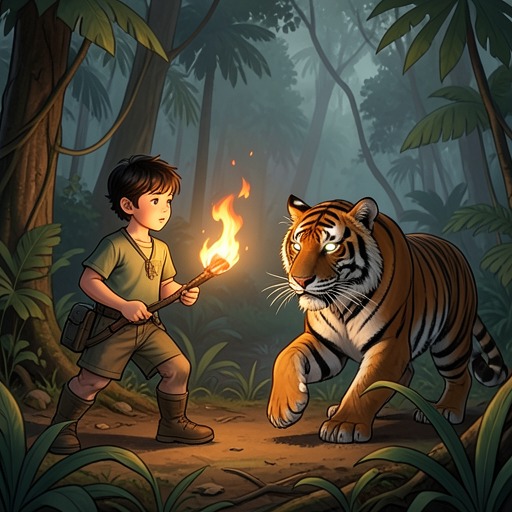
His physical reputation is reinforced by the circumstances of his arrival. Shere Khan has leapt at a woodcutter's campfire and burned his feet, leaving him furious and pursuing the man-cub in anger. When he thrusts his square head and shoulders into the cave entrance, the passage is too narrow for him to enter effectively; his forepaws and shoulders are cramped as though he were fighting inside a barrel. The confined entrance exposes a limit beneath his intimidating bulk. Father Wolf can resist him there because the tiger's power cannot simply pass through every boundary it threatens.
Demand for the Man-Cub
Shere Khan's first direct claim over Mowgli is openly possessive. He tells Father Wolf that the man-cub is his quarry, says that the child's parents have run off, and demands that the wolves give him the child. Father Wolf rejects the demand by asserting that the Wolves are a free people: they take orders from the Head of the Pack, not from a striped cattle-killer. The man-cub belongs to the wolves to kill if they choose, which means that Shere Khan has no jurisdiction over the decision.
The exchange establishes the central conflict in terms of sovereignty. Shere Khan is strong enough to frighten individuals, but the wolf community's law denies him the right to command it. His opposition to Mowgli consequently begins before the boy has done anything against him. The tiger seeks to determine Mowgli's fate because the child's human identity disturbs the boundaries by which the jungle organizes itself, while Father Wolf's answer insists that communal law matters more than a predator's appetite.
Conflict with the Pack
Years later, Shere Khan presses the same demand at the Council Rock, where Akela's failed kill has weakened the authority of the Seeonee Wolf Pack. Akela acknowledges that the Pack has the right to kill him under its law, but no wolf wishes to fight him to the death. Shere Khan exploits this hesitation. Instead of respecting the Council's immediate question, he redirects the assembly toward Mowgli, declaring that the man-cub has been his meat from the beginning and that he has been troubled by this man-wolf for ten seasons.
His language reveals both hatred and political calculation. He says that Mowgli is a man and a man's child, and that he hates him to the marrow of his bones. More than half the Pack then echoes the demand that a man should return to his own place. Shere Khan adds a further threat: if the wolves do not surrender Mowgli, he will hunt in their territory forever and give them not one bone. He presents himself as both claimant and coercive power, attempting to turn fear of human retaliation into an argument for delivering Mowgli.
Yet the scene also shows that his authority is unstable. Shere Khan calls Akela a toothless fool and dismisses the old leader's impending death, but he does not personally enforce a lawful judgment. He uses the Pack's division and the weakened position of its leader to make his own appetite appear to be public necessity. The conflict is therefore a contest between intimidation and collective freedom, not simply between a tiger and a boy.
Defeat at the Ravine
Mowgli eventually answers Shere Khan's long campaign through strategy rather than a direct contest of strength. Riding Rama, he brings the buffalo herd toward the Council Rock and orders Akela to drive them down. The herd plunges into the ravine in a mass of black horns, foaming muzzles, and pounding bodies. Shere Khan hears the charge, tries to find an escape, and discovers that the straight walls leave him no route out. He is heavy with his dinner and drink and would do anything rather than fight.
The buffaloes meet in a violent collision when Rama stumbles over something soft and crashes into the other herd. Mowgli slips from Rama's neck and helps break up the animals before they turn upon one another. Akela and Gray Brother nip at their legs while Mowgli redirects Rama and drives the herd toward the wallows. The scene reverses Shere Khan's earlier position at the cave: the tiger is again confronted by a physical boundary, but this time no narrow passage protects him and no intimidation can command an escape.
Shere Khan needs no further trampling. He is dead, and the kites are already approaching. Mowgli calls the death a dog's death, not because the tiger has been granted a heroic final combat, but because Shere Khan never shows fight. The decisive value shift is from the tiger's claimed inevitability to complete helplessness: the predator who demanded the child is reduced to a body carried by the momentum of animals organized by Mowgli.
Hide, Memory, and Narrative Significance
Mowgli immediately takes out the knife he now carries in a sheath around his neck while living with men. He says that Shere Khan's hide will look well on the Council Rock and begins skinning the ten-foot tiger. The work lasts an hour; Mowgli slashes and tears while the wolves either wait with their tongues out or tug at the hide when ordered. The act is practical, ceremonial, and political at once. Mowgli does not merely survive his enemy: he converts the tiger's body into a visible claim to the place from which Shere Khan tried to expel him.
Shere Khan's death also contrasts with the wider book's depictions of animal power and human violence. Sea Catch fights for a nursery place at Novastoshnah but does not chase a beaten seal because that would violate the Rules of the Beach; Shere Khan, by contrast, treats hunting rights and communal law as obstacles to be overridden. In the seal-killing grounds, men reduce seals to skins through organized labor, while at the ravine the buffalo herd destroys Shere Khan through collective animal force. These contrasting scenes place the tiger within a broader world in which animals possess laws, loyalties, and political judgments, even as stronger powers attempt to turn living beings into property or prey.
Shere Khan therefore functions as more than a recurring villain. He is the concentrated form of predatory entitlement: territorial expansion without consent, appetite presented as law, and fear used to divide a community. His death does not erase the tensions between the jungle and human society, but it settles the personal struggle that has shaped Mowgli's life. Once the hide lies on the Council Rock, the Big One's former reputation survives only as an emblem of the power Mowgli overcame.